
Facial balance is one of those qualities people notice without being able to name. A face reads as harmonious when its proportions relate to one another correctly, when light falls across the cheeks and jawline in an expected way, and when no single feature demands attention. Aging changes those relationships gradually, and the result is often a face that looks tired or heavier through the lower third without any obvious single cause.
At Beauty Boost Med Spa in Newport Beach, dermal filler treatments are organized as Filler Boosts, a menu of area-specific treatments designed to address those changes individually or in combination. The framing matters, because it reflects how the practice thinks about filler. The goal is not to fill a line or inflate a feature in isolation. It is to restore the structural relationships that make a face look like itself.
What Dermal Fillers Do and Why Placement Matters
Dermal fillers are gel-like substances, most commonly composed of hyaluronic acid, injected beneath the skin to replace volume that has been lost or to add support where structure has weakened. Hyaluronic acid occurs naturally in the body, integrates reasonably well into tissue, and can be dissolved if a result is not what a patient wanted. That reversibility is a meaningful safety feature.
What patients often misunderstand is that facial aging is not simply deflation. The fat compartments of the face sit in distinct layers and pockets, and they do not all lose volume at the same rate. Some descend. Bone remodels and recedes, particularly around the eye socket and the jaw. Skin loses elasticity independently of all of this. Wiegmann and colleagues, writing in the Journal of Plastic, Reconstructive and Aesthetic Surgery in 2025, argue for exactly this shift in thinking, moving filler strategy away from chasing individual lines and toward restoring the structural framework that has changed.
The practical consequence is that the place a patient notices a problem is frequently not the place that needs treatment. A deep smile line is often a mid-face volume problem. A heavy-looking jawline is often a chin projection problem. Treating the visible symptom without addressing the structural cause produces a result that looks filled rather than restored.
The Signature Beauty Boost Approach
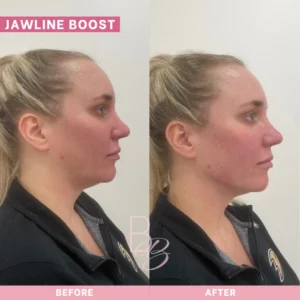
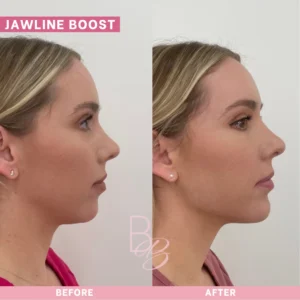
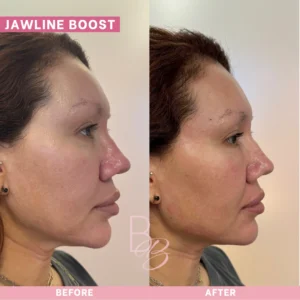
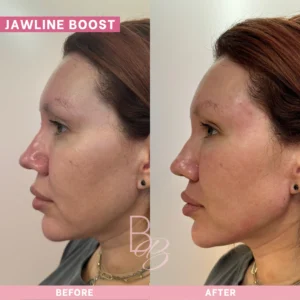
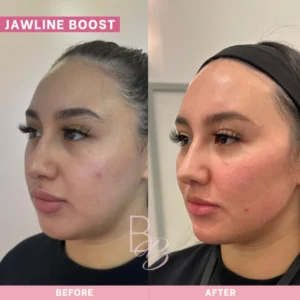
The team of expert injectors at Beauty Boost organizes filler treatments by anatomical area, each named for what it addresses. Cheek Boost restores mid-face volume and definition. Chin Boost adds projection to balance the side profile. Jawline Boost defines the mandibular angle and blends jowls. Temple Boost restores hollowing between the forehead and cheekbones. Eye Boost addresses under-eye hollows and the transition from tear trough to cheek. Lip Boost shapes and enhances the lips. Smile Line Boost, Marionette Line Boost, and Lip Line Boost soften specific perioral changes. Skin Boost improves texture and fine lines rather than adding contour.
Several of these are frequently combined, which is the reasoning behind The Facial Balance Boost, a planned combination of five targeted treatments designed together rather than accumulated one appointment at a time. Patients can also structure it as four Filler Boosts paired with Botox in the ABC areas covering the forehead, frown lines, crow’s feet, and brow. The full menu is detailed on the Filler Boosts page.
Common Concerns Patients Bring In
The concern voiced most often is looking overdone. This fear is reasonable and well-informed. Patients see examples of filler that has migrated, that sits in the wrong plane, or that was placed to satisfy a request rather than to serve the face. Nobody wants that outcome. The honest response is that the overdone appearance is usually a consequence of treating areas in isolation and continuing to add product over years without reassessment. A patient who receives lip filler repeatedly while the mid face continues to lose volume ends up with a lower third that is disproportionate to everything above it. Each individual appointment may have seemed reasonable. The cumulative result is not.
A second concern is safety, particularly around vascular complications. The face carries arteries in predictable but individually variable locations, and injecting product into or around a vessel can compromise blood supply. This is uncommon, but it is the complication that matters most.
A third concern is what happens to previous filler. Many patients arrive having been treated elsewhere and are unsure what is still present, where it sits, or whether it has moved. That uncertainty complicates any new treatment plan.
How Ultrasound Imaging Changes the Conversation
At Beauty Boost, we use ultrasound imaging as part of treatment planning, and this addresses several of the concerns above directly. Ultrasound uses high-frequency sound waves to visualize the structures beneath the skin, including blood vessels, fat pads, and tissue planes.
The clinical value is documented. Gonzalez and colleagues published a practical guide in Aesthetic Plastic Surgery in 2026 covering ultrasound imaging of high-risk facial areas for injectables, and Vasconcelos-Berg and colleagues, writing in Aesthetic Surgery Journal in 2023, describe how to integrate ultrasound into routine injectable practice. Both address the same underlying point, which is that facial vascular anatomy varies between individuals and that imaging replaces assumption with information.
Ultrasound is applied in specific situations rather than universally. It supports vascular mapping in higher-risk areas such as the nose, temples, and tear troughs. It identifies previously placed filler, including product that has encapsulated or migrated, which makes correction and dissolving far more precise. It assesses tissue planes before placement in structurally complex areas. It also supports evaluation if a complication occurs.
One clarification the practice makes explicitly is worth repeating. Ultrasound is used as a diagnostic and planning tool, and when appropriate, for reassessment during a session. It is not used to guide the needle in real time. The value is in understanding the anatomy before treatment rather than navigating during it. More detail is available on the ultrasound imaging page.
The Consultation and How Plans Are Built
Treatment at Beauty Boost begins with an assessment of the whole face rather than a discussion of the area a patient came in to address. Anisa Mudawar, DNP, and the Beauty Boost team evaluate proportion, symmetry, tissue quality, and how the areas relate to one another before recommending anything.
That assessment frequently reorders priorities. A patient requesting more lip volume may be advised that a Chin Boost would do more for the balance of the lower face, and that lips can follow once the profile is corrected. A patient concerned about smile lines may be better served by mid-face support through a Cheek Boost. Sequencing also matters, because treating a structural area first often reduces how much product is needed elsewhere.
Where existing filler is present, and its position is uncertain, imaging or dissolving may come before any new placement. The Reset Boost dissolver uses hyaluronidase to break down unwanted hyaluronic acid filler, with results continuing to improve over the following forty-eight hours. Starting from a clean baseline produces a better outcome than layering new product over old.
For patients whose primary concern is skin quality rather than structure, Skin Boost addresses fine lines and texture directly. A systematic review by Ghatge and colleagues in Clinical, Cosmetic and Investigational Dermatology in 2023 examined injectable hyaluronic acid used specifically for facial skin quality and found consistent improvement in hydration, elasticity, and surface roughness.
What to Expect
Our Signature Filler Boost treatments involve minimal downtime. Swelling and tenderness are expected and generally settle within twenty-four to seventy-two hours, though lips swell more noticeably and take longer to settle than other areas. Bruising occurs in a meaningful minority of patients and typically resolves within five to seven days. Most patients return to normal activity the same day.
Results are visible immediately, but the immediate result is not the final one. The product needs time to settle and integrate with surrounding tissue, and the accurate assessment point is roughly two weeks after treatment. Lip Boost includes a complimentary two-week follow-up for this reason, which is when refinement, if any is needed, should be discussed.
Duration depends on the product, the area, and the individual. Structural areas such as the chin, jawline, and cheeks tend to hold longer than the lips, which metabolize product faster because of constant movement and rich blood supply. A general expectation of six to eighteen months is reasonable, with structural areas at the longer end.
Regarding outcomes, filler restores volume and supports structure. It does not tighten skin, and it does not lift tissue that has descended significantly. A patient with substantial laxity who is treated with filler alone will end up looking heavier rather than lifted, which is precisely the outcome nobody wants. When laxity is the dominant issue, collagen-stimulating treatments, threads, or energy-based skin tightening are more appropriate, and Beauty Boost will say so. Examples of the practice’s filler outcomes are available in the fillers gallery.
Scheduling a Consultation in Orange County
Facial balance is the product of an accurate assessment, an appropriate sequence, and restraint. The Filler Boost menu exists to make that process specific rather than abstract, so patients understand exactly what each treatment addresses and why it was recommended. Beauty Boost Med Spa serves patients in Newport Beach and the surrounding Orange County communities. To schedule a consultation with Anisa Mudawar, DNP, and the Beauty Boost team, visit the contact page. Patients who treat regularly may also want to review the membership options.
Before & Afters